
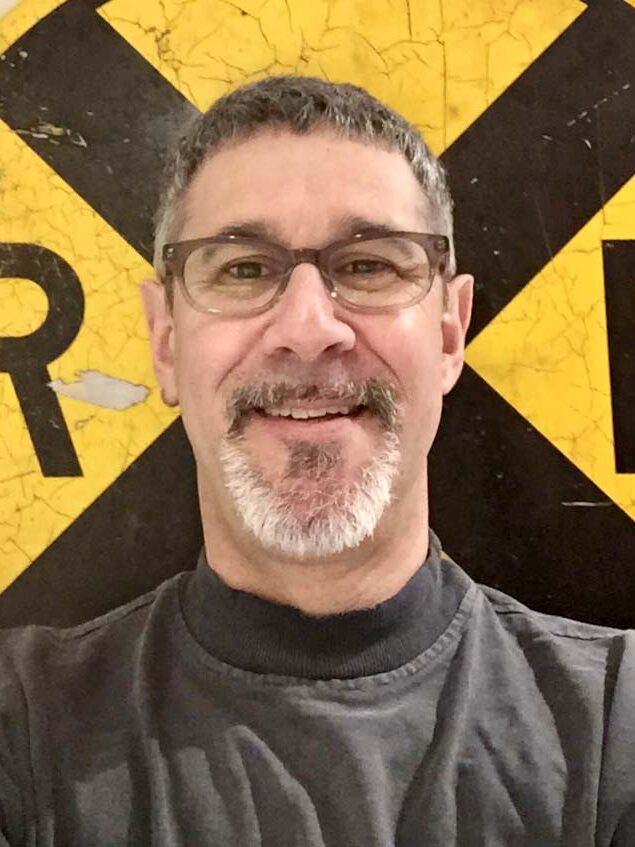
Bernard Hellen is a model railroader, designer, entrepreneur and the founder of miniprints.com, a Canadian manufacturer of highly detailed 3D-printed figures, animals, and details for model railroaders. Known to many in the hobby as “dr. mini,” Bernard has spent much of his time thinking about how small details can tell much larger stories.
Bernard came to model railroading with a background in marketing and graphic design. That perspective has shaped his approach to the hobby. Rather than seeing a model railroad simply as a collection of trains, structures, and scenery, he is fascinated by the people, animals, objects, and everyday moments that give a miniature world a reason to exist.
That philosophy eventually led to miniprints, which Bernard founded in 2020. Using 3D scanning, digital sculpting, and resin printing, miniprints has grown from an experiment in creating unusual details into a catalogue of figures and scenes designed to put life—and sometimes a little humour—into model railroads around the world.
Bernard is also the creator of miniprints University, an educational initiative exploring the ideas behind model railroading rather than simply the techniques used to build one. Its first course, Why Do We Model?, examines the motivations, memories, creativity, storytelling, and personal connections that draw people to the hobby.
Through his monthly live broadcasts, clinics, videos, writing, and conversations with other model railroaders, Bernard has become increasingly interested in a deceptively simple question: What makes a model railroad feel alive?
On Art in Model Railroading:
For Bernard, the art of model railroading begins with storytelling.
A beautifully modeled locomotive can be extraordinary. A perfectly weathered building can be extraordinary. But put a tired worker beside that locomotive, a dog waiting outside that building, a couple having an argument on a sidewalk, or a child staring through a fence at a passing train, and something changes. We stop looking only at models and begin imagining what is happening there.
That is where Bernard believes much of the art resides.
Model railroaders are world-builders. We compress geography, manipulate time, choose what to include and what to leave out, and combine thousands of individual decisions into a miniature reality. Some modelers pursue extraordinary prototype accuracy; others build places that never existed. Both are exercising the same fundamental artistic ability: choosing what matters and using it to communicate an idea.
Bernard also believes that model railroading is deeply personal. We build places we remember, places we wish we remembered, places that disappeared before we were born, and places that have never existed anywhere except in our imaginations. Our layouts inevitably contain pieces of ourselves.
That is why there is no single correct way to practice the art of model railroading. The goal isn’t perfection. The goal is to create something that makes us feel something—and, if we’re fortunate, allows somebody else looking at our miniature world to feel something too.
Because ultimately, trains may be what brought many of us to model railroading. But the stories are what bring the railroad to life.