
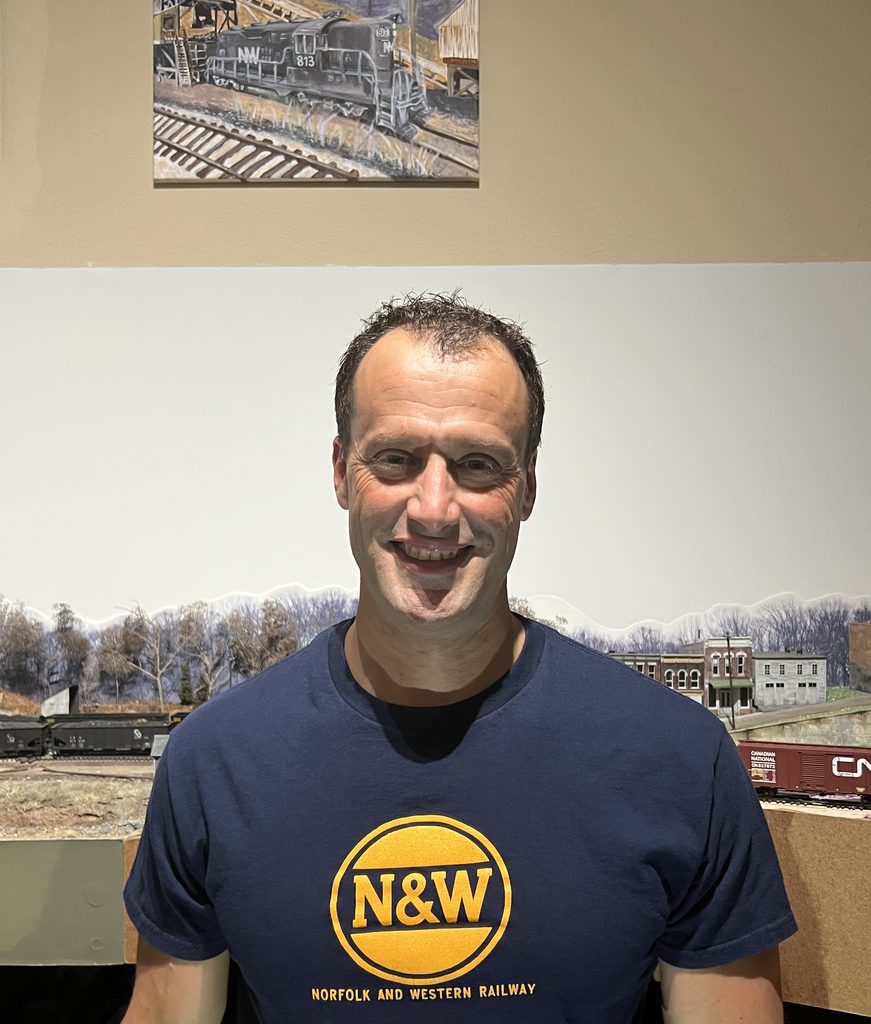
My name is John Haney, and I’m one of the Post-Interview Show Hosts on the Art of Model Railroading Podcast. Like many model railroaders, I got hooked on trains at a very young age. Growing up in New England, one of my earliest memories is watching a Maine Central Railroad train make its way across the Mountain Division through New Hampshire’s White Mountains when I was about four years old. Not long after that, my father introduced me to model trains, and that’s where it all started.
The hobby has been a part of my life ever since, although there were a few years when life got busy and I stepped away from it. In 2019, I jumped back into model railroading full-time and began building my own Appalachian-themed railroad. After spending time in Virginia, I developed a real appreciation for the coal-hauling railroads of Appalachia, with its scenery, buildings, and culture, that became the focus of my modeling. Today, I enjoy bringing that region to life through my layout, combining my love of trains, history, and modeling into a hobby that continues to inspire me. I hope to share this inspiration with my fellow modelers on the AOMR Podcast.
One of the concepts that has had the biggest impact on how I view model railroading comes from Frank Ellison’s The Art of Model Railroading. Frank talks about the importance of “producing a play” with your railroad, and that idea has always stuck with me.
I believe most of us are in this hobby because we want to recreate something that inspires us from the real world. Whether it’s a favorite railroad, a memorable location, or a specific era, we all have something that draws us in. We can buy all the locomotives, rolling stock, structures, track, and scenery materials we want, but Ellison believed that every element on a layout should have a purpose. That philosophy has influenced the way I think about my own railroad. I often ask myself questions like: What is the purpose of my railroad? Why is this locomotive on the roster? What role does this industry or structure play? The more I ask those questions, the more realistic and engaging the railroad becomes. Always have a backstory.
Ellison also wrote that once the track is laid and the structures are built, we stop being model builders and become stage directors. As soon as the first train starts moving across the layout, the railroad comes to life. I think that idea has helped shape the hobby over the years. We’ve seen a shift from simply watching trains run in circles to building layouts that tell a story through operations. Many modelers, myself included, have discovered that even a small point-to-point railroad can provide a highly detailed setting and an operating session that keeps you engaged.
Another point Ellison emphasized was the importance of keeping people interested and wanting more. I think that applies not only to operators, but more importantly to the railroad owner. Changing up operating patterns, introducing different traffic, or trying new ways to run the railroad helps keep things fresh and enjoyable for the owner. After all, part of the fun of this hobby is that there’s always something new to explore—whether it’s a locomotive, a freight car, or a new way of operating.
To me, Frank Ellison was truly ahead of his time. He helped transform the hobby from simply collecting and running model trains into something much bigger: The Art of Model Railroading.